Terms & Conditions
Welcome to emkaan.com. These Terms & Conditions govern your access to and use of the EMKAAN website, including all content, services, and information made available through it. By accessing or using this Website, you confirm that you have read, understood, and agreed to be bound by these Terms.
If you do not agree with any part of these Terms, please discontinue use of the Website. EMKAAN may update or amend these Terms at any time, and your continued use of the Website after any change constitutes acceptance of the revised Terms.
Definitions
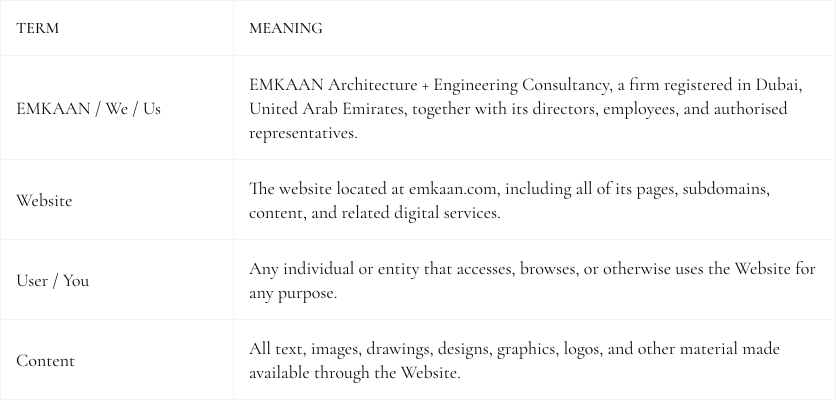
Throughout these Terms & Conditions, the following words carry the meanings set out below, unless the context clearly requires otherwise:
USE OF THE WEBSITE
You agree to use this Website only for lawful purposes and in a manner that does not infringe the rights of, or restrict the use and enjoyment of, this Website by any third party. You must not attempt to gain unauthorised access to the Website, its servers, or any connected system or network, nor use the Website to transmit any harmful, misleading, or unlawful material. EMKAAN may suspend, restrict, or withdraw access to all or part of the Website at any time and without prior notice where it considers it necessary to do so.
INTELLECTUAL PROPERTY RIGHTS
All Content on this Website is the property of EMKAAN or its licensors and is protected by applicable copyright, trademark, and other intellectual property laws. The following conditions apply:
• You may view, download, and print extracts of the Content for your own personal, non-commercial reference only.
• You may not reproduce, distribute, republish, modify, or commercially exploit any Content without the prior written consent of EMKAAN.
• The EMKAAN name, logo, and all related marks are trademarks of EMKAAN and may not be used without authorisation.
• Architectural drawings, design concepts, and project imagery remain the intellectual property of EMKAAN and are shown for illustrative purposes only.
• Any unauthorised use of the Content may give rise to a claim for damages and/or constitute an offence under applicable law.
SERVICES, QUOTATIONS & PROJECT ENGAGEMENTS
The Website provides general information about EMKAAN’s architectural, interior design, and engineering consultancy services. Such information is provided for guidance only and does not constitute a binding offer. Please note the following:
• Any enquiry submitted through the Website does not create a contractual relationship until a separate written agreement is signed by both parties.
• Quotations, timelines, and project scopes are subject to a detailed consultation and may vary based on site conditions, client requirements, and regulatory approvals.
• Visuals and case studies shown on the Website reflect past or conceptual work and are not a guarantee of specific outcomes for future projects.
DISCLAIMERS & LIMITATION OF LIABILITY
While EMKAAN takes reasonable care to keep the information on this Website accurate and up to date, it is provided on an “as is” basis without warranties of any kind, whether express or implied. To the fullest extent permitted by law:
• EMKAAN does not warrant that the Website will be uninterrupted, error-free, or free from viruses or other harmful components.
• EMKAAN shall not be liable for any direct, indirect, or consequential loss arising from your use of, or inability to use, the Website.
• It is your responsibility to ensure that any information or material obtained from the Website meets your specific requirements before relying on it.
THIRD-PARTY LINKS, PRIVACY & GOVERNING LAW
This Website may contain links to third-party websites that are not operated or controlled by EMKAAN. We are not responsible for the content, policies, or practices of any third-party websites, and access to them is entirely at your own risk. Your use of the Website is also governed by our Privacy Policy and Cookies Policy, which explain how we collect and process personal data.
These Terms & Conditions are governed by and construed in accordance with the laws of the United Arab Emirates and the applicable regulations of the Emirate of Dubai. Any dispute arising in connection with these Terms shall be subject to the exclusive jurisdiction of the courts of Dubai.