


Al Fanar School: The Architecture of Discovery Beyond Time
Some buildings declare themselves through scale or spectacle.
Al Fanar School does neither.
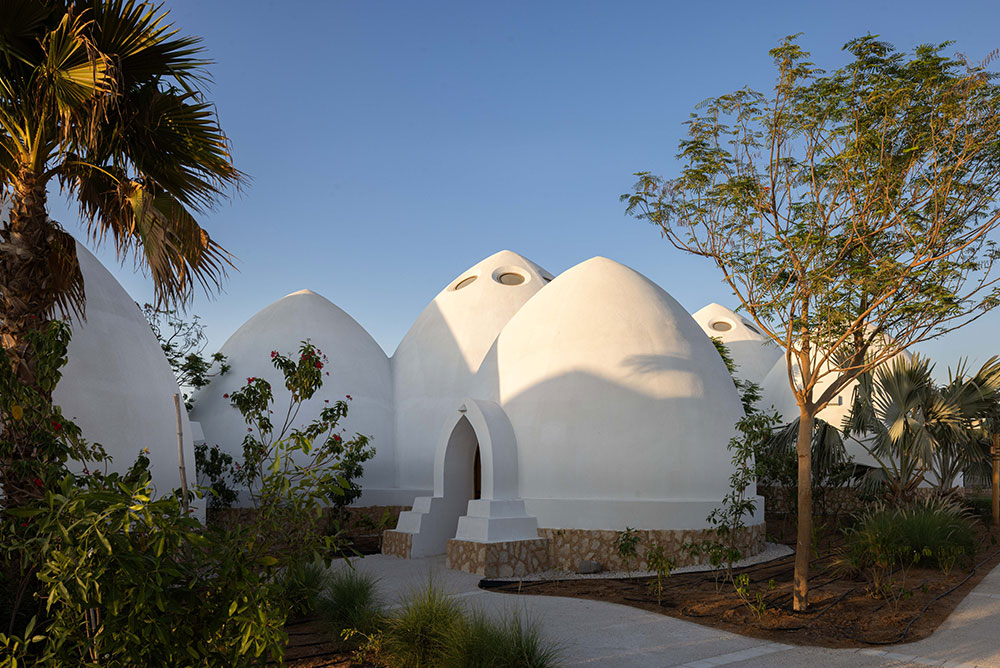
Instead, it pulls you inward—quietly, gently, through sensation. Before your eyes interpret its form, your senses do. The soft curvature of white walls, the ambient glow descending from dome-top skylights, the subtle hush of shaded courtyards… every detail slows you down just enough to notice that something extraordinary is happening here.
Designed by EMKAAN as a learning environment shaped more by nature, light, and sensory experience than by conventional school typologies, Al Fanar School reframes the meaning of educational architecture. This is not a building that teaches children what to learn.
It teaches them how to feel while learning.
In a city known for futuristic skylines, Al Fanar offers something rare: a place that feels both ancient and futuristic, both familiar and otherworldly. A place where architecture becomes a quiet mentor.
In this conversation, Muhammad Obaid (Founder and Principal Architect – EMKAAN) reflects on the philosophies that shaped the school’s identity—a place where walls embrace like protective arms, where sunlight becomes a guide throughout the day, and where design becomes an active participant in discovery.
Al Fanar School — A Landscape of Learning
In Conversation with Muhammad Obaid, Founder and Principal Architect – EMKAAN
BROWNBOOK:
I can’t place Al Fanar School in any sort of aesthetic category. It looks like something somebody would build in outer space.
MUHAMMAD OBAID:
What you described is exactly what I intended to achieve with the design: You don’t know if it’s from the past or the future, but in both cases, it feels familiar. One of the good things about Dubai is that it has its own culture while also accommodating and attracting other cultures. So, if you’re designing a school, it needs to incorporate elements from each culture so that everyone feels familiar with the place.
BB:
I see some similarities to the Iranian architect Nader Khalili’s work with sandbag shelters in Iran. What were your influences?
MUHAMMAD OBAID:
Nader Khalili’s building technique indeed served as an initial inspiration, particularly his modular approach with sandbag construction. In my design for Al Fanar School, I adapted and enhanced this concept to meet the unique needs of the project. Key elements, such as optimizing the size, number, and position of the windows within the dome structure, were essential modifications. These adjustments were challenging, but they allowed me to optimize sunlight orientation and natural lighting, creating an environment where students can benefit from natural light – ideal for their learning experience.
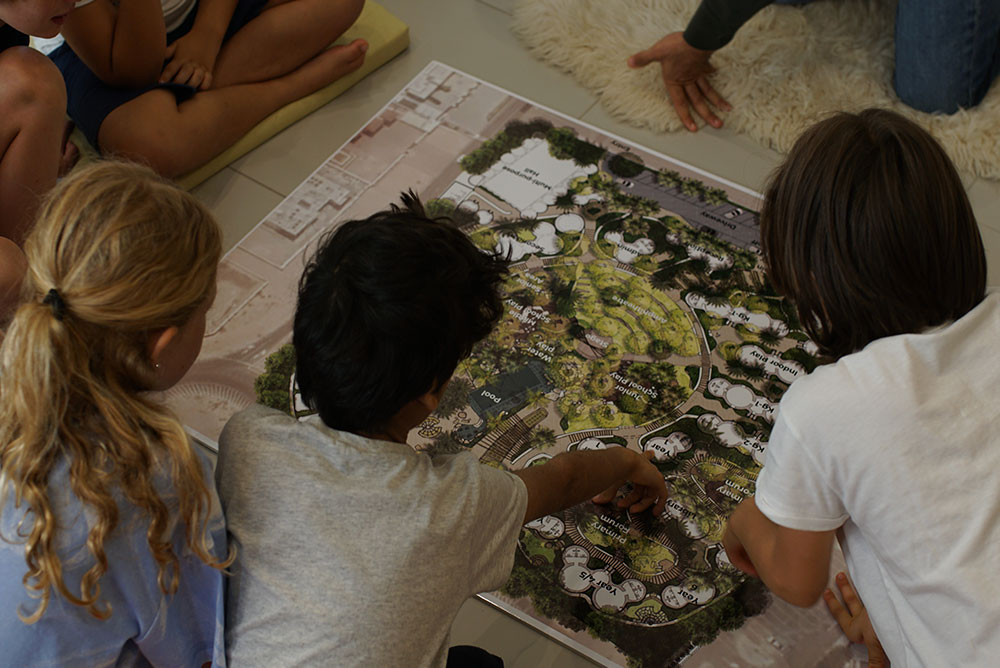
For the overall arrangement and masterplan of the school, I drew inspiration from various sources. One key influence was my professor, Ashraf Botros, who introduced me to the work of Professor Abdelhalim Ibrahim Abdelhalim on the Children’s Cultural Park. This project, with its spiral design, represented growth and movement, concepts that resonated deeply with my vision for Al Fanar School. The spiral form in my design symbolizes continuous growth and an inviting journey of learning.
BB:
And that’s why the site’s buildings are arranged in a spiral formation?
MUHAMMAD OBAID:
When I visited the Far East, I learned about a symbol from Japanese culture—the koi carp—which also represents growth and development. This inspired me to create the initial lines of the master plan for the school. That’s why, if you look at the school from above, it sometimes resembles a koi fish and sometimes gives the impression of a spiral.
BB:
What was the brief like from your client?
MUHAMMAD OBAID:
The client’s brief was centered on creating a nurturing and familiar environment for young children. They emphasized the importance of providing a space that would feel comforting and recognizable, particularly for children in their early developmental stages. Inspired by this vision, I integrated curvatures and organic shapes into the architecture to foster a sense of warmth and protection. The curved forms of the buildings symbolically represent a womb, encapsulating the nurturing essence of a mother and reinforcing the school as a safe, welcoming environment for growth and exploration.
BB:
How did you create such organic-looking structures?
MUHAMMAD OBAID:
Initially, we aimed to construct the school using traditional sandbag building techniques, similar to rammed earth methods. We gathered sand, filled bags, and stacked them to form the structure. However, during the approval process, we encountered challenges, particularly with fire resistance requirements. As a result, we pivoted to a faster, widely accepted construction method that aligns with Dubai’s regulations: concrete.
BB:
Did that change the design in any way?
MUHAMMAD OBAID:
Switching to concrete offered us flexibility to explore any geometry we envisioned. However, instead of opting for a flat roof, I wanted to honor the design journey we had embarked on. The choice to incorporate the apse shape, with its historical resonance—spanning from ancient pharaonic architecture to modern design—allowed us to connect with a legacy of architectural forms.
In tackling the design challenges of this project, I often likened our journey to that of a koi carp. Like the koi, we faced the choice between overcoming obstacles or settling for simplicity. Choosing the path of perseverance, we transformed each obstacle into an opportunity to create something exceptional, rather than defaulting to a basic, uninspired structure.
This project became more than just a building; it embodies the values of flexibility, persistence, and growth. In a way, it mirrors the lessons we hope to impart to every student—a story of perseverance, adaptability, and the courage to shape one’s own future.
BB:
What are the challenges of making this sort of building a reality?
MUHAMMAD OBAID:
The only challenge we faced was with the blackboard that the teachers use. We have a curved wall inside, making it difficult to place a straight blackboard against it. We managed to put in a freestanding blackboard, which improved the classroom dynamics.
BB:
Was that something you had designed intentionally?
MUHAMMAD OBAID:
I wanted the children to be able to monitor the sun throughout the day, so we needed to provide natural light inside the space. We spent a lot of time studying that. The kids are only at school from morning until about 2 pm or sometimes 3 p.m. If I placed the openings on the sides, then they wouldn’t have the chance to see light casting shadows on the walls. By bringing the windows to the top of the dome, they can better observe the dramatic movement of sunlight. Imagine the sun moving around the dome throughout the day; it casts shadows, and the areas where the sun hits the windows create light spots on the wall that move. When the sun dips in the afternoon, its rays climb up the wall again. I wanted the children to feel this movement of the sun—to connect them to nature and the universe.
BB:
The school sits apart from the rest of the work in your portfolio. What has the experience been like for you?
MUHAMMAD OBAID:
It was truly priceless. I had the chance to meet not only the teachers and the head of the school but also the children themselves. I listened to their needs. The time between the design and completion of the project was only about a year. So, those who were in Year 3 became Year 4, and they still remembered the entire process. What was even more amazing was their feedback after being in the school once it had been built. Hopefully, I positively impacted their lives.
BB:
What’s the response been like?
MUHAMMAD OBAID:
Honestly, the feedback I’ve been getting since the beginning of the school year in September has been positive. I’ve received feedback from teachers, children and the head of the school, and Alhamdulillah, everyone is happy. The children say it looks like a Star Wars movie. Neighbors have mentioned it looks like a Hobbit house. I take it all as a compliment; it was exactly what I wanted…to look like something out of this world… Science Fiction…
At the same time, when the children say it reminds them of a resort, I try to translate these emotions into something tangible. I think they mean that the curvature and lighting make them feel tranquil.
Also, the feedback from teachers has been very positive, especially regarding the classroom lighting. The natural light levels are carefully balanced—not too bright to cause distraction, nor too dim to make students feel drowsy. This intentional lighting design supports an engaging and comfortable learning environment, allowing students to remain focused and energized throughout the day.
BB:
Back to my original question. How would you describe the style of building?
MUHAMMAD OBAID:
I can’t classify it as belonging to the past, future, modern day, or anything else, but I’m certain it’s a result of thinking about people. There are many well-known star architects who have led architectural trends, like Zaha Hadid. You can identify her style instantly. My approach to architecture focuses on people. I apply the same philosophy to all my projects. It’s about thinking of people first—about their happiness and joy.
Al Fanar School: Where Architecture Becomes Experience
Al Fanar School is more than an academic institution; it is a living, breathing landscape of learning where light, form, and nature shape children’s daily experiences. Through the vision of Muhammad Obaid, the school becomes a place that transcends time—rooted in tradition yet radiant with a futuristic sensibility.
This conversation reveals more than architectural mechanics.
It uncovers a philosophy made tangible:
A world where curiosity is sculpted by light, where movement is taught by shadow, and where space itself becomes a gentle mentor.
Al Fanar School stands as a testament to what happens when architecture is designed not just for people—but around their senses, emotions, and inner world.

